What if the highest-rated lock on the market is completely useless because your door frame is slightly warped? Many facility managers in Kern County assume that better security always means buying a more expensive deadbolt, but the reality is often found in the hinges and closers. When you’re investing in commercial door security hardware Bakersfield, it’s easy to feel overwhelmed by shifting ADA requirements or the fear of overpaying for complex systems you don’t actually need.
We understand that a door that won’t latch properly is more than just a nuisance; it’s a liability that disrupts your daily operations and compromises safety. This article will debunk five common myths that lead to security gaps and unnecessary expenses. You’ll discover why professional security focuses on diagnosing the entire door opening, from the floor threshold to the panic hardware. We’ll provide the expert guidance you need to keep your facility secure, fully compliant with the 2026 California Building Standards Code, and operating smoothly every day.
Key Takeaways
- True security starts with the entire door opening, ensuring that frames, hinges, and closers are properly aligned to support your lock’s performance.
- Investing in high-quality commercial door security hardware Bakersfield, such as ANSI Grade 1 components, protects your facility from the wear and tear of high-traffic use.
- Keyless entry upgrades aren’t just for corporations; they offer small businesses a practical way to manage employee access without the recurring costs of rekeying.
- Staying compliant with the latest California Building Standards Code requires more than just ramps, as specific hardware like lever handles is mandatory for accessibility.
- A professional diagnosis identifies hidden issues like door sag or improper closing force that a general contractor might overlook during a standard repair.
Beyond the Lock: Why the Entire Door Opening Matters for Bakersfield Businesses
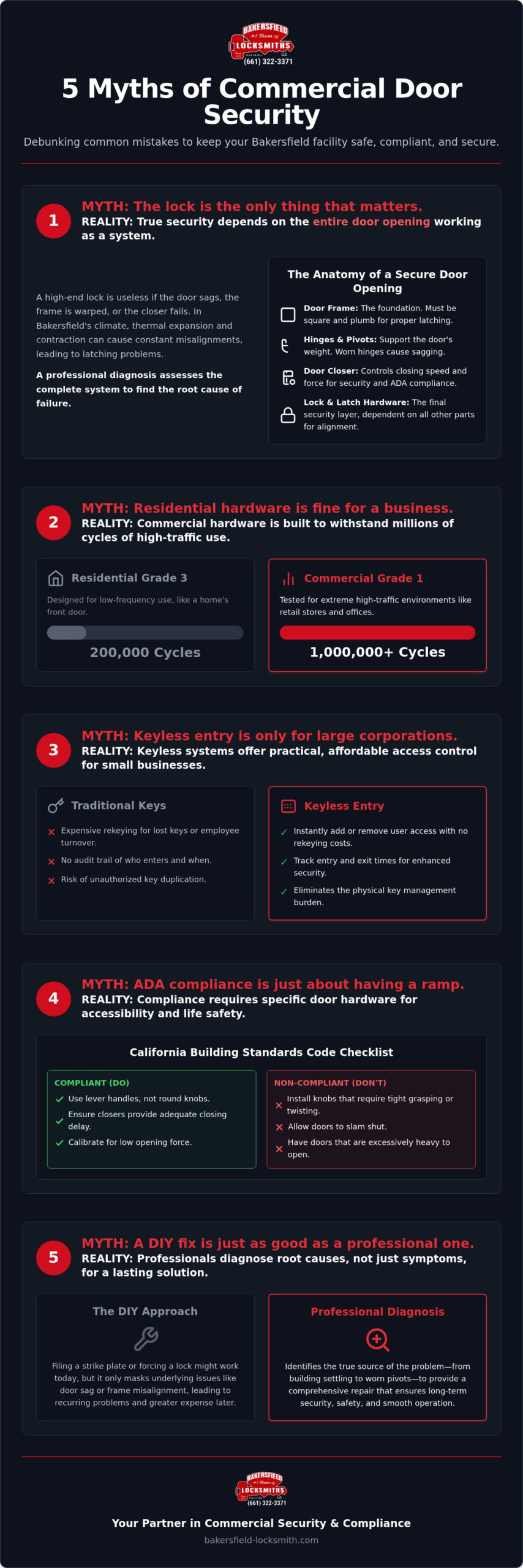
When a door fails to secure properly, the immediate reaction for many facility managers is to replace the lock. This stems from a common misconception: the belief that the lock is the only component responsible for your building’s safety. We call this Myth #1. In reality, your security relies on a complex system where every part must work in harmony. We believe the Entire Door Opening Matters more than any individual piece of hardware. This philosophy shifts the focus from a single point of failure to the health of the entire assembly, including the frame, hinges, and closers.
Bakersfield businesses face environmental factors that many hardware manufacturers don’t account for. Our extreme summer temperatures cause metal doors and frames to expand and contract significantly. This thermal movement leads to alignment shifts that can make even the highest quality commercial door security hardware Bakersfield businesses invest in feel like it’s malfunctioning. A door opening diagnosis is the evaluation of all integrated hardware components to ensure they function as a single, secure unit. Without this holistic view, you’re likely to keep paying for new locks that will continue to fail due to underlying structural issues.
The Role of Commercial Hinges and Pivots
Hinges are the mechanical foundation of any door. When they become worn or loose, the door begins to sag, leading to “door dragging” or rubbing against the frame. You might notice your door is harder to pull open or that it leaves marks on the floor. Simply replacing a lock on a sagging door won’t solve your security gap. If the door isn’t hanging straight, the latch won’t sit properly in the strike plate, leaving the door technically “unlocked” even if the bolt is thrown. For high-traffic retail storefronts in Kern County, we often recommend heavy-duty pivots. Unlike standard hinges, pivots distribute the door’s weight more effectively, preventing the common sag that plagues busy entrances.
Commercial Door Alignment and Latching Issues
If your door won’t latch on its own, it’s rarely a sign of a broken lock. It is almost always an alignment issue caused by building settling, frame shifts, or worn closers. A door that won’t stay closed creates an immediate security risk and an invitation for unauthorized entry. We often see facility managers try to “DIY” these fixes by filing down strike plates, but this only masks the problem. Professional alignment, which involves Panic Bar Repair, Door Closer Adjustment, and Commercial Door Alignment, addresses the root cause. This methodical approach saves your business money by preventing hardware wear and ensuring your facility remains code-compliant and secure.
Debunking the “One-Size-Fits-All” Myth of Commercial Security Hardware
Thinking that residential locks are sufficient for a business is a costly mistake. This is Myth #2: the idea that “light-commercial” use justifies “big box” store hardware. Residential locks are built for low-cycle use, typically found in a home where a door opens a few times a day. In a Bakersfield retail space, that same door might open 500 times or more. Without a Professional Hardware Diagnosis of your traffic patterns, you risk installing hardware that will fail within months. ANSI/BHMA Grade 1 commercial door security hardware Bakersfield businesses require is tested to withstand one million cycles. Compare that to residential Grade 3 locks, which only require 200,000 cycles. Storefront doors often use narrow-stile hardware, which requires specialized installation knowledge to fit within the thin metal frames of glass entries. Using the wrong hardware leads to premature wear on the frame and the lock itself.
Commercial Door Closers: Adjustment vs. Replacement
A slamming door isn’t just an annoyance; it’s a liability. Ignoring a malfunctioning closer can lead to finger injuries or damaged frames. Door closers are hydraulic systems requiring precise calibration to manage opening force and closing speed. If your door is hard to open or slams shut, it may just need a valve adjustment rather than a full replacement. However, if you see oil leaking from the body, the internal seals have failed and the unit is no longer safe. Professional calibration ensures your door meets the maximum 5-pound opening force requirement for interior doors. Getting a professional to look at your commercial door alignment ensures your closers work in tandem with your locks and latching hardware.
Panic Bars and Exit Devices: Security Meets Safety
Panic hardware is a critical safety component required by California code for buildings with high occupancy. These devices ensure that anyone can exit a building quickly during an emergency without needing to turn a knob or use a key. You’ll find three main types: rim devices, surface vertical rods, and concealed vertical rods. Rim devices are the most common and easiest to maintain. If your panic bar won’t retract or feels “mushy” when pressed, the internal springs or dogging mechanisms are likely worn. Since these are life-safety devices, they must be kept in perfect working order to avoid heavy fines during fire inspections. Proper maintenance prevents the bar from sticking, which can happen when the door frame shifts or the latch becomes misaligned. Regular inspections of these systems provide the peace of mind that your facility is both secure and safe for the public.
The High-Tech Myth: Is Electronic Access Control Practical for Kern County Small Businesses?
Many small business owners in Kern County assume that electronic access control is a luxury reserved for government buildings or massive agricultural corporations. This is Myth #3. In reality, modern keyless entry upgrades are often more cost-effective for a small office or retail shop than traditional mechanical keys. When an employee leaves your company, the traditional response is to rekey every lock they had access to. This is a recurring expense that drains your maintenance budget. By transitioning to commercial door security hardware Bakersfield businesses can manage, you eliminate the need for physical rekeying. You simply revoke a digital credential and the problem is solved.
Stand-alone electronic locks have become a staple for small Bakersfield offices. These units provide the security of a Grade 1 lock with the convenience of a keypad or proximity reader. Credential systems, including fobs, cards, and mobile smartphone credentials, allow managers to track who enters the building and at what time. According to 2026 industry data, 29% of organizations have already transitioned to mobile credentials. This technology allows you to send a temporary “key” to a delivery driver or a cleaning crew right from your phone, providing total control without ever leaving your desk.
Buzzer Entry Systems and Remote Release
Buzzer entry systems are an excellent solution for professional offices and retail storefronts that require a layer of screening before allowing entry. These systems use a combined intercom and electrified release to let you see or hear a visitor before granting access. Integrating this electrified door hardware with your existing security system creates a seamless experience for both staff and visitors. Many modern systems now offer app-controlled locks, giving you the ability to release a door for a late-arriving employee even if you’re off-site. It’s a simple technical remedy that provides significant peace of mind for business owners.
Electrified Hardware vs. Maglocks
Choosing between an electric strike and a magnetic lock (maglock) is a critical decision that impacts both security and life safety. Electric strikes replace the standard strike plate in the door frame and work with your existing lockset. They are often preferred because they can operate in a “fail-secure” mode, meaning the door remains locked from the outside even during a power outage. Magnetic locks, on the other hand, use a powerful electromagnet to hold the door closed. Because maglocks require constant power to stay locked, fire codes often mandate that they be integrated with the building’s fire alarm system to ensure they release during an emergency. Professional installation is vital here to ensure your facility remains compliant with California’s strict safety standards.
Safety vs. Security: Common Misconceptions About ADA Compliance and Life Safety
A frequent error among Kern County facility managers is assuming that ADA compliance is limited to ramps and parking spaces. This is Myth #4. Under the 2025 California Building Standards Code (Title 24), which went into effect on January 1, 2026, the specific mechanics of your door hardware are under intense scrutiny. Traditional “knob-style” locks are almost always non-compliant in commercial Bakersfield settings because they require a pinching or twisting motion to operate. To meet current accessibility standards, door hardware must be operable with one hand without tight grasping. Transitioning to lever-style commercial door security hardware Bakersfield inspectors look for is one of the most effective ways to prevent costly lawsuits and failed inspections.
Professional ADA door hardware corrections go beyond just swapping handles. They involve a deep look at how the door interacts with the user. If your hardware is difficult to operate or the door itself is too heavy, your building is a target for accessibility-related litigation, which is a major source of construction legal issues in California.
ADA Standards for Door Opening Force
The “5-pound rule” is a critical benchmark for interior commercial doors. According to current regulations, the maximum force required to push or pull open an interior door cannot exceed 5 pounds. For exterior doors, the limit is 8.5 pounds. In many older Bakersfield commercial buildings, door closers are often cranked up to high tension to force a misaligned door to latch. While this might “fix” a latching problem, it creates a compliance failure by exceeding the legal opening force. Precise door closer adjustment is the technical remedy that balances the need for a secure latch with the legal requirement for accessible entry. We often find that correcting the frame alignment allows the closer to work at a lower, legal tension.
Fire Code and Exit Hardware
The tension between physical security and fire safety often leads to dangerous mistakes. Some business owners attempt to secure rear fire exits with padlocks or slide bolts to prevent break-ins. This is a severe violation of California fire code and can lead to immediate closure of your facility by the Fire Marshal. Every exit door must be openable from the inside without a key or special knowledge whenever the building is occupied. This is known as “single-motion” egress. Panic devices are designed specifically for this purpose, releasing the latch with no more than 15 pounds of force. Our team regularly assists with government and municipal safety projects, providing the expert guidance needed to navigate these overlapping regulations. If you are concerned about your facility’s compliance, you can schedule a professional hardware diagnosis to ensure your exits meet every legal standard.
Securing Your Facility: Why Professional Hardware Diagnosis Beats DIY Troubleshooting
Many facility managers believe a general contractor has the necessary skills to repair a commercial door. This is Myth #5. While a contractor is skilled in general construction, the commercial door security hardware Bakersfield businesses rely on requires a specialized understanding of mechanical tolerances and code requirements. A licensed locksmith doesn’t just look at a broken part; they diagnose the entire opening. This approach identifies why a component failed in the first place, whether it was due to frame settlement, improper closer tension, or hinge wear. By addressing the root cause, we ensure your facility remains secure and functional for the long term.
Professional troubleshooting prevents the common trap of “parts-changing.” This happens when an inexperienced repairman replaces a lock only to find the door still won’t latch because the frame is out of alignment. By identifying the root cause, we help you avoid unnecessary hardware purchases and ensure that the components you do invest in last for their full rated cycle life. Professionally maintained Grade 1 hardware can last over a million cycles, but only if it’s installed and aligned correctly. This precision protects your long-term investment and ensures your doors don’t disrupt your daily business operations or create safety hazards for your staff and customers.
The Bakersfield Locksmith Advantage
Since 1995, we’ve served as a stable pillar in the Kern County community. Our team brings decades of experience to every project, from complex prevailing-wage municipal assignments to high-traffic retail storefronts. We’ve seen every possible scenario and know exactly how to handle the unique challenges of our local environment, including the heat-related expansion issues mentioned earlier in this guide. While we are specialists in commercial locksmith management, we maintain a deep commitment to residential security as well. This dual focus ensures that whether you’re managing a government facility or securing your home, you’re receiving advice from a seasoned expert who follows the highest legal and ethical standards.
Next Steps for Facility Managers
Scheduling a security hardware audit is the first step toward a more secure, code-compliant facility. During a professional commercial door alignment service, we evaluate every component of the opening. Our methodical process includes Panic Bar Repair, Door Closer Adjustment, and Commercial Door Alignment to ensure your entryways function perfectly. We check for proper latching, verify that opening forces meet ADA standards, and ensure that panic hardware is functioning correctly for life safety. This comprehensive review provides you with a clear roadmap for repairs or upgrades, allowing you to prioritize the most critical security needs first without being rushed into unnecessary sales.
Contact Bakersfield Locksmith for a Commercial Hardware Diagnosis
Mastering Your Facility’s Security and Compliance
Effective security isn’t achieved by simply buying a stronger lock. It requires a holistic approach that considers the alignment of the frame, the health of the hinges, and the precision of the door closer. By debunking these common myths, you can see that maintaining your facility’s safety involves navigating complex ADA standards and fire codes. Investing in the right commercial door security hardware Bakersfield businesses need is about ensuring every component works in harmony to protect your employees and your bottom line.
We’ve served as Kern County’s commercial door experts since 1995, helping property managers avoid the pitfalls of DIY troubleshooting and generic hardware. As a licensed and fully insured team specializing in ADA and fire code compliance, we provide the technical diagnosis needed to keep your facility running smoothly. Whether you’re upgrading to keyless entry or correcting a slamming door, we provide the peace of mind that comes from honest, professional service.
Get Expert Commercial Door Hardware Service in Bakersfield
Your facility’s security is our priority, and we’re ready to help you build a safer, more efficient workplace today.
Frequently Asked Questions
Do I need a new door if my commercial door won’t latch properly?
You rarely need a full door replacement for latching issues. Most problems stem from frame shifts or worn hinges that cause the latch to miss the strike plate. We focus on commercial door alignment to correct these mechanical gaps. By adjusting the hinges or the door closer, we can often restore perfect function to your existing opening. This diagnosis saves you the significant expense of a new door while ensuring your facility remains secure.
What is the difference between Grade 1 and Grade 2 commercial hardware?
The primary difference lies in durability and cycle life. ANSI Grade 1 commercial door security hardware Bakersfield facilities require is tested for one million cycles, making it ideal for high-traffic main entrances. Grade 2 hardware is designed for light-commercial use, typically tested for 400,000 cycles. While Grade 2 is suitable for interior office doors with lower traffic, Grade 1 provides the heavy-duty performance needed for retail storefronts and high-use perimeter doors.
Are panic bars required for all Bakersfield businesses?
Panic bars are not required for every business, but they are mandatory for certain occupancy levels and building types under California code. Generally, assembly, educational, and high-hazard occupancies with 50 or more people require panic hardware on exit doors. Since codes vary based on your specific industry and building use, a professional hardware diagnosis is the best way to determine if your facility currently meets Kern County fire safety requirements.
How often should commercial door closers be adjusted?
You should have your closers checked at least twice a year, specifically during seasonal temperature shifts. In Bakersfield, extreme summer heat can thin the hydraulic fluid inside the closer, causing the door to slam. Conversely, colder winter mornings can thicken the fluid, making the door hard to open. Regular door closer adjustment ensures your entryways stay within the legal 5-pound opening force limit while still latching securely every time the door closes.
Can I upgrade to keyless entry without replacing my entire door?
Yes, most commercial doors can be upgraded to keyless entry without a full replacement. We specialize in installing stand-alone electronic locks and electrified door hardware that integrate with your existing frames and doors. Whether you need a simple keypad lock or a complex credential system for employee access, these upgrades can be retrofitted to your current opening. This provides a modern security boost and eliminates the recurring cost of rekeying after staff turnover.
What makes a door ADA compliant in California?
ADA compliance involves several factors beyond just having a ramp. In California, doors must have a minimum clear opening width of 32 inches and a threshold no higher than 0.5 inches. The hardware must be operable without pinching or twisting, which typically requires lever handles rather than knobs. Additionally, the interior opening force must not exceed 5 pounds. We provide specialized ADA door hardware corrections to help Bakersfield businesses avoid accessibility-related litigation.
Do you provide residential locksmith services in Bakersfield as well?
We certainly do. While we are known as commercial door experts, we maintain a strong commitment to residential security throughout Kern County. Our residential services include full-home rekeying for new homeowners, lock installation, and smart lock setup. We help residents secure their homes with the same professional reliability we bring to our commercial projects. Whether you need guest-code setup or a high-security deadbolt installed, we are your local neighborly professionals.
Why is my commercial door dragging on the floor?
A dragging door is usually caused by worn hinges or pivots that have allowed the door to sag over time. This is a common issue in high-traffic Bakersfield storefronts where the constant weight of the door wears down the mechanical foundation. If left unaddressed, dragging can damage your flooring and strain the door frame. We solve this by repairing or replacing the commercial hinges and pivots, restoring the door’s proper height and alignment.