How much does a single lost master key actually cost your Bakersfield business when you factor in the emergency rekeying of every exterior door and the legal liability of a potential security breach? For many facility managers, the answer is a staggering figure that goes far beyond the price of a new cylinder. You probably already know the daily drain of staff members wasting time hunting for shared keys or the quiet anxiety that comes with realizing an ex-employee never returned their credentials. It’s a logistical burden that feels like an inevitable part of doing business, but it doesn’t have to be.
By implementing modern commercial key management systems, you can transform your security from a reactive expense into a streamlined asset. This guide will show you how to eliminate unauthorized access and reduce long-term overhead through professional key control. We’ll examine the shift toward electronic credentials, explain how to maintain compliance with the 2026 California Building Standards Code (Title 24), and provide a roadmap for building a scalable system that offers total visibility into your Kern County facility’s daily operations.
Key Takeaways
- Learn how modern commercial key management systems move beyond simple storage to provide real-time audit trails and accountability for every entry point.
- Compare the long-term reliability of mechanical master key systems with the remote deactivation and scalability of electronic credential management.
- Identify the hardware specifications required to maintain compliance with 2026 California Building Standards and ADA accessibility requirements.
- Discover how smart lockers and RFID tracking can eliminate the high costs of emergency rekeying and the liability of lost master keys.
- Understand why a professional site survey is essential for identifying hidden security vulnerabilities before investing in new facility hardware.
What is a Commercial Key Management System?
A commercial key management system is more than just a place to hang keys. It’s a centralized protocol designed to track, store, and authorize access to every physical and digital key within a business environment. While a traditional locksmith focuses on the hardware of a single door, commercial key management systems focus on the entire ecosystem of your facility. This infrastructure ensures that every key is accounted for, from the moment it’s cut until it’s retired or deactivated.
At its core, a key management system (KMS) manages the full lifecycle of access credentials. For a business owner, this means moving away from the “honor system” and toward a framework of professional reliability. By implementing a structured system, you reduce the risk of unauthorized duplication and lower your facility’s liability. Many insurance providers look favorably on these systems, as they prove a business is taking proactive steps to secure sensitive assets and maintain a safe workplace.
From Key Rings to Audit Trails: The Evolution of Access
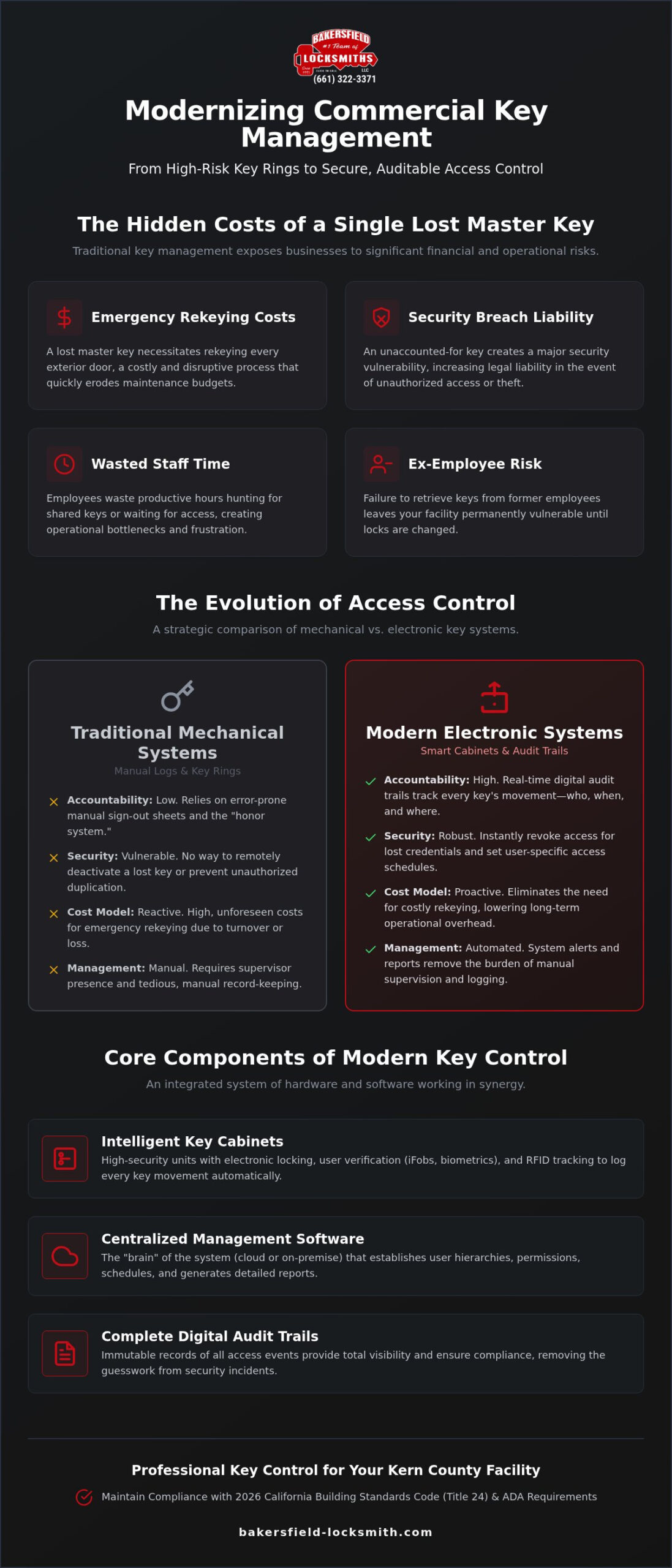
Traditional key rings and manual sign-out sheets often fail in modern commercial environments because they lack accountability. If a master key goes missing, a manual log can’t tell you exactly when it disappeared or who had it last. Modern systems replace these passive storage methods with active management tools. Instead of a simple keyboard in a manager’s office, you utilize smart lockers or high-security cabinets that require a unique credential for access.
This shift creates a digital audit trail. Every time a staff member retrieves a key, the system records the time, date, and user identity. If a key isn’t returned by a specific time, the system can trigger an alert. This automation removes the burden of manual record-keeping from your supervisors and ensures that “who, when, and where” are always documented without human error.
Why Key Management Matters for Bakersfield Facilities
In Kern County, our local economy relies on sectors with unique security challenges. Bakersfield retail and service businesses often deal with high employee turnover, making it difficult to track physical keys as staff members come and go. Without a structured system, the cost of rekeying locks every time a manager leaves can quickly erode your maintenance budget. A managed system allows you to revoke access instantly without replacing physical hardware.
Our agricultural and industrial hubs face different risks. These facilities often house expensive equipment, sensitive chemicals, or proprietary data across sprawling sites. Structured key control ensures that only authorized personnel can enter high-value areas. By eliminating the ‘hidden cost’ of lost keys, local businesses can protect their bottom line while providing peace of mind to their stakeholders and employees.
Core Components of Modern Key Control Infrastructure
A successful security infrastructure isn’t just about a locked box; it’s about the synergy between storage, software, and the actual door hardware. In 2026, commercial key management systems rely on this multi-layered approach to maintain robust key control practices across diverse facilities. While competitors often focus solely on the storage cabinet, a seasoned expert knows that the system is only as strong as its weakest link, which is frequently the integration between the key and the lock cylinder itself.
Intelligent Key Cabinets and Electronic Tracking
Smart cabinets serve as the first line of defense. These high-security units use electronic locking mechanisms and individual key slots to restrict access based on pre-defined schedules. This functionality is particularly useful for multi-shift operations in Bakersfield’s agricultural or manufacturing sectors, where employees can check keys in and out without a dedicated supervisor present. RFID key tracking is the standard for 2026 accountability, using radio frequency identification to uniquely identify and log every individual key movement automatically. By utilizing iFobs or biometric readers, these cabinets verify identity before a single key is released, ensuring that sensitive areas remain protected.
Management Software and Digital Credentials
The “brain” of the system is the management software. Local firms must choose between cloud-hosted platforms, which offer remote management and scalability, and on-premise databases for higher localized control. A well-configured system establishes a clear hierarchy where administrators manage the entire database, managers oversee specific departments, and employees only access what’s necessary for their specific duties. Integrating this tracking with your broader facility security, such as alarm systems or video surveillance, creates a unified defense that provides total visibility into your daily operations.
For a system to be truly effective, it must integrate with the physical hardware on your doors, including ADA-compliant levers and panic devices. Per the 2026 California Building Standards Code, all ADA-compliant door hardware must be mounted between 34 and 48 inches above the finished floor. If your key management software issues a credential for a door that doesn’t meet these accessibility or fire code requirements, your facility faces significant liability. Ensuring your commercial locksmith management plan includes a hardware audit is a vital step for maintaining long-term compliance and peace of mind. This holistic approach protects your business from both unauthorized access and costly regulatory fines.
Mechanical vs. Electronic Systems: A Strategic Comparison
Choosing between mechanical and electronic commercial key management systems isn’t about finding a “right” or “wrong” technology. It’s about matching the technical remedy to your facility’s specific environment and operational pace. Mechanical systems provide a “set it and forget it” reliability that many Kern County business owners appreciate for their simplicity and cost-effectiveness. Meanwhile, electronic upgrades offer the granular, real-time control necessary for high-traffic environments where staffing changes are frequent and audit trails are a legal or insurance requirement.
The Power of High-Security Master Key Systems
High-security master key systems remain a staple for professional facility management. They utilize restricted keyways, which means keys can’t be duplicated at a local hardware store without specific, written authorization from the system owner. This is the bedrock of professional key control. A well-designed hierarchy allows a single master key to open every door in the building, while sub-masters grant access only to specific departments like maintenance or shipping. For perimeter security where power might be unreliable or infrastructure is aging, mechanical locks are often the most resilient choice. They don’t require batteries or network connections to keep your property secure, making them a “gold standard” for external gates and remote storage units.
The Advantages of Electronic Access Upgrades
Electronic management shines when your workforce is fluid. One of the greatest advantages is the ability to revoke credentials remotely. If an employee leaves your organization, you don’t need to pay for a physical rekeying of your exterior doors; you simply deactivate their digital access in the management software. This significantly reduces long-term maintenance overhead and eliminates the stress of unreturned keys. These systems also provide automated alerts if a key is overdue or if someone tries to access a restricted zone after hours. For Bakersfield businesses growing into multiple sites, the scalability of cloud-based electronic access is unmatched, allowing you to manage several facilities from a single dashboard.
Deciding which path to take often comes down to door count and user volume. A small retail shop might thrive on a mechanical master key system, while a large healthcare facility or agricultural processing plant requires the detailed audit trails of an electronic system. Most modern facilities find the best balance through a hybrid approach. This involves using mechanical high-security locks for exterior perimeters while implementing electronic tracking for interior offices or sensitive server rooms. This strategy delivers the best of both worlds: robust physical protection and modern digital accountability.
Compliance, ADA Standards, and Life Safety in Bakersfield
Implementing commercial key management systems involves more than selecting high-tech software; it requires a deep understanding of the legal frameworks governing physical access. In Kern County, all commercial projects submitted for a permit on or after January 1, 2026, must comply with the updated California Building Standards Code (Title 24). Failing to meet these requirements doesn’t just invite regulatory fines; it creates significant liability if an emergency egress is blocked or if a facility is inaccessible to individuals with disabilities.
ADA-Compliant Hardware Integration
Accessibility is a fundamental requirement for every business in the Bakersfield area. When integrating key control, you must ensure that all ADA-compliant access hardware, such as levers and pulls, meets specific force requirements. For interior doors, the maximum opening force is 5 pounds; for exterior doors, it is 8.5 pounds. These hardware components must be operable with one hand and without tight grasping, pinching, or twisting of the wrist.
Mounting height is equally critical for universal access. All ADA-compliant door hardware and key management cabinets must be mounted between 34 and 48 inches above the finished floor. ADA compliance is a legal necessity for all Bakersfield commercial properties to ensure that every employee and visitor, regardless of physical ability, can navigate the facility safely and independently.
Local Fire Codes and Emergency Egress
The intersection of security and life safety is most evident during a building evacuation. You must choose between fail-safe and fail-secure locking mechanisms based on the specific room’s function and fire code requirements. Fail-safe locks unlock automatically when power is lost, ensuring a clear exit path during a fire. Fail-secure locks remain locked to protect assets, which is often required for perimeter doors where manual panic devices allow for immediate egress from the inside without a key.
Maintaining the integrity of fire-rated doors is a specialized task. Any modification to these doors during the installation of electronic strikes or exit alarms must follow strict guidelines to preserve their fire-resistance rating. Additionally, coordinating with the Bakersfield Fire Department on lock box requirements, such as a Knox Box, ensures that emergency responders can access your property without causing destructive entry. Professional installation by a licensed expert is mandatory for legal compliance in Kern County, ensuring your system protects both your property and the people inside it.
Partnering with a Licensed Bakersfield Locksmith for Implementation
Successful implementation of commercial key management systems begins with a physical, boots-on-the-ground assessment. While some national providers suggest DIY setups or remote support, these methods often miss the subtle structural vulnerabilities that only a local expert can spot during a walkthrough. A professional site survey identifies these gaps before you invest in expensive hardware. This ensures your security roadmap is tailored specifically to your facility type, whether you’re managing a sprawling agricultural complex in the Central Valley or a high-traffic retail storefront downtown.
The Advantage of Local, Professional Management
In California, the Bureau of Security and Investigative Services (BSIS) licenses both individual locksmiths and companies. Partnering with a licensed and fully insured professional who has served Kern County since 1995 ensures your system is installed according to these strict legal and ethical standards. If a project exceeds $500 in labor and materials, state law requires the contractor to hold a valid C28 Lock and Security Equipment license. Avoiding the pitfalls of uncertified “handyman” installations is vital; uncertified work can lead to hardware failure, code violations, and even voided insurance claims if a breach occurs.
Building a relationship with a neighborly professional provides ongoing peace of mind that a remote vendor simply can’t match. Security needs aren’t static; they evolve as your business grows or as local regulations change. Having a local support team means you receive a rapid response for system adjustments, hardware maintenance, and urgent credential updates. This proximity is essential for maintaining the long-term reliability of your infrastructure and ensures that your business remains a stable, secure pillar of the local economy.
Taking the Next Step: Your Facility Security Audit
During a professional commercial security consultation, you should expect a methodical and highly organized evaluation of your property. We act as a protective guide, helping you navigate complex needs by offering advice for different types of entries. The goal is to prioritize upgrades logically, starting with high-traffic perimeter doors and panic devices before moving to sensitive internal storage or server rooms. This phased approach allows you to manage your security budget effectively while immediately addressing your most significant points of liability.
A customized security roadmap provides a clear path from your current challenges to a state of total visibility and control. By combining old-school values of honesty and hard work with modern, high-tech innovations, you can secure your assets without the stress of constant rekeying. Ready to master your facility’s access? Contact Bakersfield Locksmith for a comprehensive facility security evaluation and take the first step toward a more professional and resilient security ecosystem.
Securing the Future of Your Bakersfield Facility
Effective security in 2026 requires moving beyond simple locks and towards integrated commercial key management systems. The right infrastructure doesn’t just prevent unauthorized access; it streamlines your daily operations and ensures your property remains compliant with the latest ADA and California Building Standards. Whether you choose a high-security mechanical master key system or an advanced electronic platform, the goal is to replace the stress of unreturned keys with the peace of mind that comes from total visibility.
Building a resilient security ecosystem is a long-term investment in your business’s stability. As locally owned and operated professional providers in Kern County since 1995, we specialize in delivering licensed and insured solutions tailored to our community’s unique needs. Our team is expert in installing ADA-compliant commercial hardware that meets strict legal requirements while protecting your assets. Don’t leave your facility’s safety to chance or uncertified handymen. Secure your facility with a professional key management system from Bakersfield Locksmith and gain the confidence that your property is protected by a seasoned expert. We’re here to help you navigate every technical detail and build a safer environment for your employees and stakeholders.
Frequently Asked Questions
What is the difference between access control and key management?
Access control regulates who can pass through a specific door in real-time using electronic readers and credentials. In contrast, commercial key management systems focus on the physical security and accountability of the keys themselves. While access control manages the entry point, key management uses smart cabinets to track who has a physical master key or vehicle key at any given moment, providing a complete audit trail for your facility.
How much does a commercial key management system cost for a small office?
The cost of implementing a system depends on the number of keys being tracked and the level of automation your business requires. While there is an initial investment for hardware and software, it’s important to consider the long-term savings from reduced emergency rekeying expenses and lower liability. We recommend a professional site survey to determine the most cost-effective hardware configuration for your specific Bakersfield office layout and security needs.
Are electronic key cabinets difficult to manage for non-technical staff?
Modern electronic key cabinets are designed for intuitive, self-service use by employees with minimal training. Users typically identify themselves via a PIN, biometric scan, or an existing employee credential to release a specific key. The management software automates the logging process, so administrative staff don’t have to manually track sign-out sheets. This simplicity reduces human error and ensures that your facility operations remain efficient and secure.
Do I need to replace all my locks to implement a key management system?
You don’t always need to replace every lock to implement a professional key management system. Many protocols can be integrated with your existing commercial hardware or installed in phases. For example, you might start by securing your current master keys in an electronic cabinet. A licensed professional can evaluate your current door hardware to see which components are compatible with modern tracking technology and which may require upgrades.
How does a master key system help with emergency access?
A master key system provides rapid access during a crisis by allowing authorized personnel to open any door with a single credential. This eliminates the need for first responders or facility managers to carry bulky key rings or search for specific keys during an emergency. Coordinating these systems with local Bakersfield fire department requirements ensures that emergency services can enter your building quickly and safely without causing destructive entry or property damage.
What happens to the key system if the power goes out?
Professional systems are designed with power failure contingencies to maintain both security and life safety. Electronic cabinets typically include internal battery backups that keep the system operational for several hours. Additionally, your door hardware is configured as either fail-safe or fail-secure. Fail-safe locks unlock during a power loss to allow for emergency egress, while fail-secure locks remain locked from the outside to protect your assets until power is restored.
Can key management systems track vehicle keys as well as building keys?
Yes, commercial key management systems are highly effective for tracking vehicle fleets alongside building keys. By using RFID tags, you can monitor exactly which driver has a specific truck or forklift key and for how long. This is particularly valuable for Bakersfield’s agricultural and industrial sectors, where managing equipment access is just as critical as securing the main facility perimeter and protecting sensitive internal storage areas.
Is it legal to have restricted keys that cannot be duplicated at a hardware store?
It is entirely legal and highly recommended to use restricted, patent-protected keyways for commercial properties. These keys require specific, written authorization and specialized equipment to duplicate, which prevents unauthorized copies from being made at local retail stores. This legal protection is a cornerstone of professional key control, ensuring that your master key system remains secure and that you always know exactly how many keys are in circulation.